
Ok first off, a trigger warning. This book is about a school shooter.
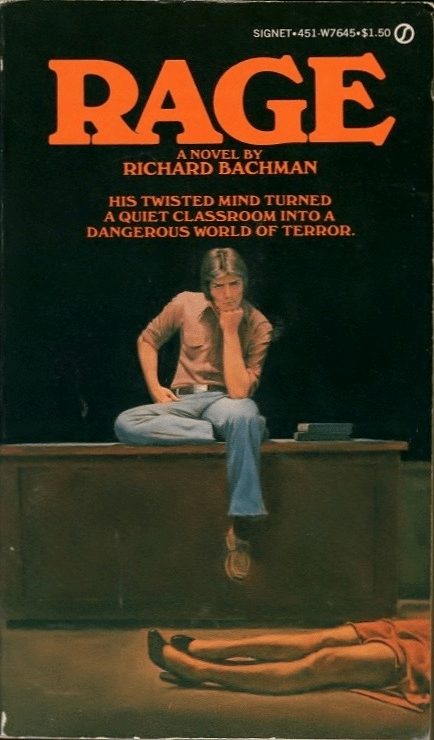
That said, I’m a little torn about how to review this book. The topic is so much more in our face now than when the book was written. We’ve all been affected by the epidemic of mass shootings in the US. My 11-year-old son has lockdown drills and we’re all more wary when we’re out in public. I’m wary of saying something that can be misconstrued. Not that I have any controversial opinions about school shootings. They’re bad and they’re an indicator of a mental health crisis in our country. I don’t think many people would disagree with those two thoughts. The more nuanced arguments people make may or may not play a role, but the mental health crisis is probably the most important. How we fix that is much harder to figure out.
Rage was written in 1977 by Richard Bachman. A few years later, Bachman was outed as a pseudonym of Stephen King. In the Introduction to the Bachman compilation book, King gives several reasons for writing under a pseudonym, my favorite being that he wanted to see how well books would sell without his name attached. In terms of books, Rage did ok, but in terms of Stephen King books, even at this early point in his career, it flopped. Later, when everyone knew who Bachman was, the sales went up significantly. Funny enough, since I knew it was Stephen King, I could tell within a few pages that he wrote the book. The character development, the setting, it was all very King. He noted people were asking him if he was Bachman almost as soon as the book hit the shelves. Even so early in his career, his style stood out.
The other reason for publishing under a pseudonym and probably the one that made the ultimate decision to publish as such was that the publishers themselves believed there were too many (?) King books coming out at that time. I’m not certain this was the reason, but I’ve seen this mentioned a few times now. Whatever the reason, it makes for an interesting history of the few Bachman books we have.
In Rage, a teenage boy is expelled from his school for attacking a teacher and proceeds to burn his locker, shoot his teacher, take his class hostage, and shoot another teacher (administrator?). The remainder of the book bounces between the events in and around the classroom and the stories about the past told by the main character and the other students. The main character doesn’t kill any of his classmates and is shot by the police, ending the standoff. The book is being told by the main character after the shooting and his recovery while he’s in a mental institution.
Rage was taken out of print in 1998 after numerous incidents, both shootings and hostage-takings, that resembled the book in one way or another. King, feeling disconcerted that his work may have influenced such actions, asked his publisher to remove the book from print. They complied and now, the book is only available used and I’ve only found it (at a reasonable price) in the compilation book with three other Bachman novels that are still in press. Incidentally, the first printing of Rage is for sale at Abebooks.com for a mere $15,000. Oh and it’s signed by Stephen King.
So, why was it written in the first place? King has said the book drew upon his own frustrations and pains in high school. He knew they were reflective of mental illness, as well. I couldn’t relate as well to the main character’s specific issues, but I could empathize. His father treated him poorly and no one was in tune with his mental state. He had issues with other students and teachers. He had an embarrassing encounter with a girl in the book, but he seemed to get along with the girls for the most part. I had the impression the main character was a Holden Caulfield type, the Catcher in the Rye version. Did you know Salinger wrote multiple versions of Holden Caufield in his career and they weren’t always the same angry kid? His anger revolved around his father and the school administrators. Ultimately, Holden didn’t shoot up his school or anything so dramatic, but his angst left an impression on many high school students because we all have frustrations, anxiety, anger, etc. in high school. Holden captures that, and I wouldn’t be surprised if he was a template for Charlie, King’s shooter.
Do I feel like Rage caused school shootings? No, of course not. There are so many images in our society a troubled youth can draw from for inspiration. Rage may have come early relative to the timeline of school shootings in the US and maybe someone was inspired by it, but I can’t fault it. I remember Marilyn Manson being blamed for Columbine.

Image above from https://www.kerrang.com/columbine-how-marilyn-manson-became-mainstream-medias-scapegoat
Others have taken blame for school shootings as well. Jeremy by Pearl Jam has been tied to school shootings (https://www.newyorker.com/culture/cultural-comment/pearl-jams-jeremy-and-the-intractable-cultural-script-of-school-shooters) and was written about a suicide in 1991 in a classroom. Pumped Up Kicks by Foster the People was written to highlight mental health issues leading to school shootings and was removed from some radio stations after the Sandyhook Elementary incident .
Personally, my son has been understanding the meaning of songs more recently and gave me a shocked look when he finally understood the lyrics of Pumped Up Kicks. I told him the purpose of the song, and we discussed the importance of talking about our feelings and getting help. Because of this, I think books like Rage and the music I mentioned can be important in educating our kids about their own metal health.
At the end of all this, I’d say the book was pretty decent. It’s short at 131 pages. I found myself feeling sympathy for all the students. Each one had some traumatic experience that made them understand Charlie. That could also be my biggest complaint about the book. The reaction to the initial shooting and being held hostage was unrealistic to me with the exception of one student. Ted was the popular, jock-type and consistently seemed to be looking for a way to get out of the situation. The other students played along with Charlie. They told their own stories. One even left the classroom to use the restroom and came back. The situation seemed more than a little unlikely.
On to The Shining. It’s the first big, well-known, popular King book I’ve never read. I’ve also never seen the movie, so all new for me.

 S. E. Baran